Abstract
Background: In patients with shock, whether noninvasive blood-pressure monitoring is an effective alternative to the recommended use of an arterial catheter is uncertain.对于休克患者而言,目前尚不确定无创血压监测是否能有效替代临床推荐的动脉置管监测方式。
Methods: In this multicenter, open-label, noninferiority trial, we randomly assigned patients who had shock and had been admitted to an intensive care unit within the past 24 hours to receive early insertion (<4 hours after randomization) of an arterial catheter (invasive strategy) or to be monitored with an automated brachial cuff (noninvasive strategy). Insertion of an arterial catheter was allowed later in patients assigned to the noninvasive-strategy group who met prespecified safety criteria. The primary outcome was death from any cause at day 28 (noninferiority margin, 5 percentage points). Adverse events of special interest related to the blood-pressure-monitoring device that was used were recorded, as was patient-reported pain or discomfort related to the ongoing presence of the device.在这项多中心、开放标签、非劣效性临床试验中,我们将过去24小时内入 ICU(重症监护病房)的休克患者随机分配至早期置入动脉导管组(侵入性策略组,即在随机化后<4小时内进行动脉置管)或使用自动臂式袖带进行血压监测组(非侵入性策略组)。对于分配至非侵入性策略组但符合预先设定的安全性标准的患者,允许在后续进行动脉导管置入。主要终点为第28天全因死亡率(非劣效性界值为5个百分点)。同时记录了与所使用血压监测设备相关的特别关注的不良事件,以及患者因持续使用该设备而报告的疼痛或不适情况。
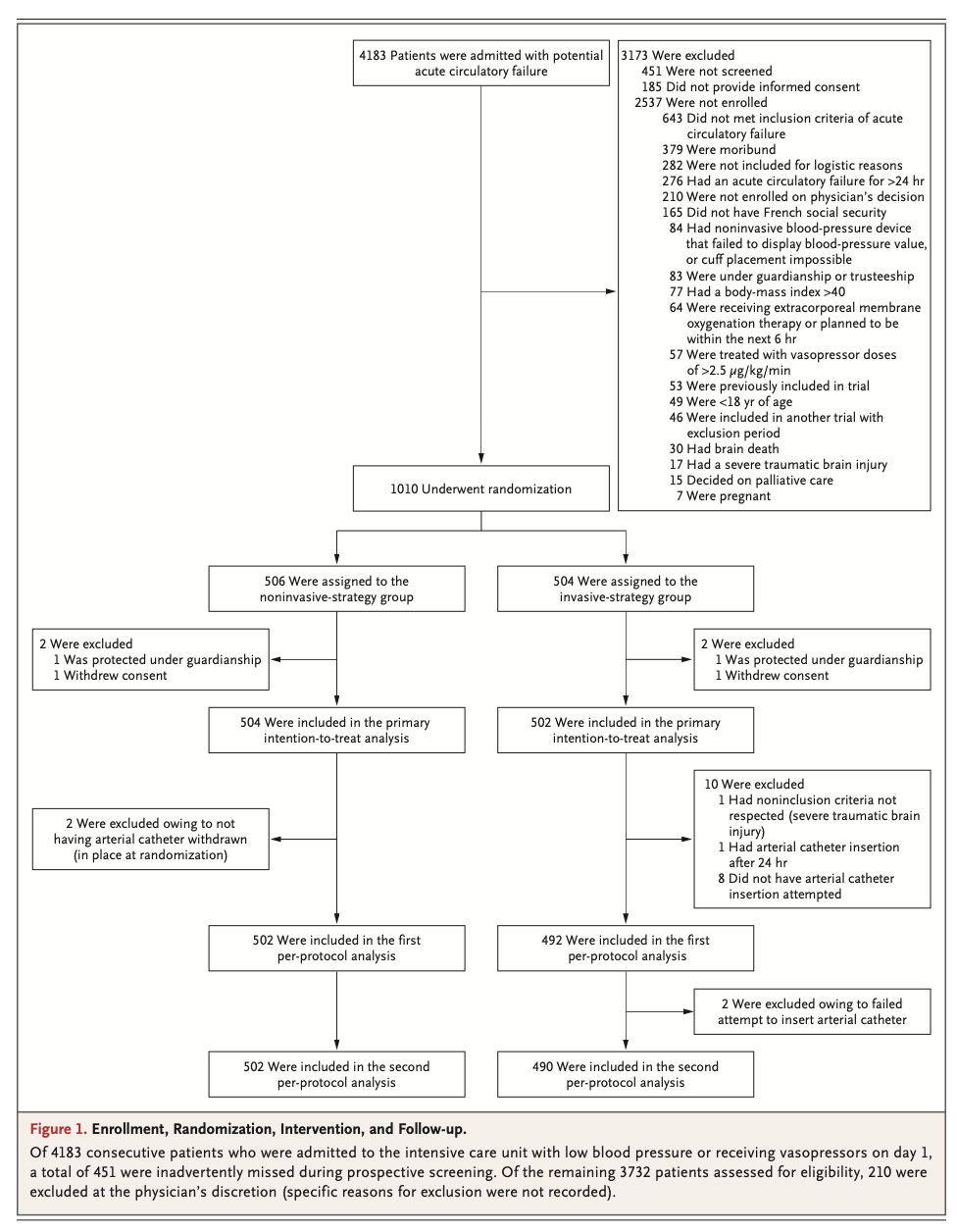
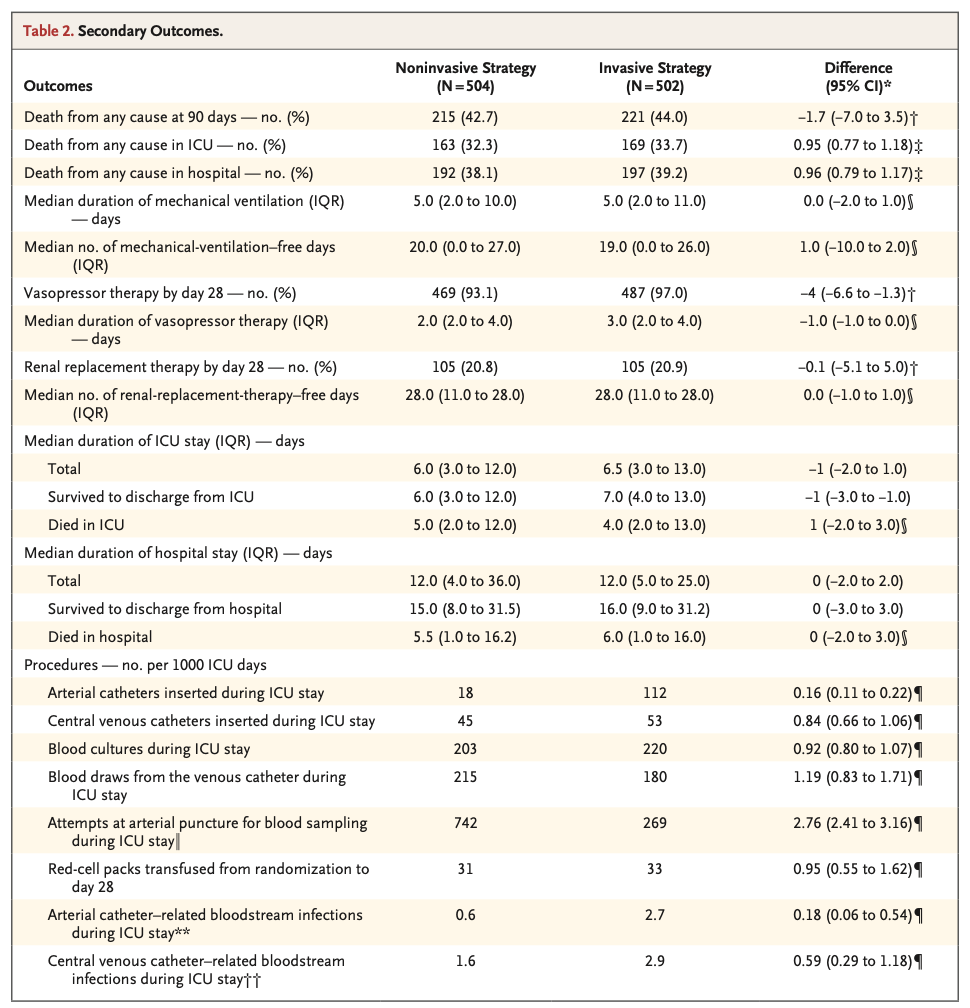
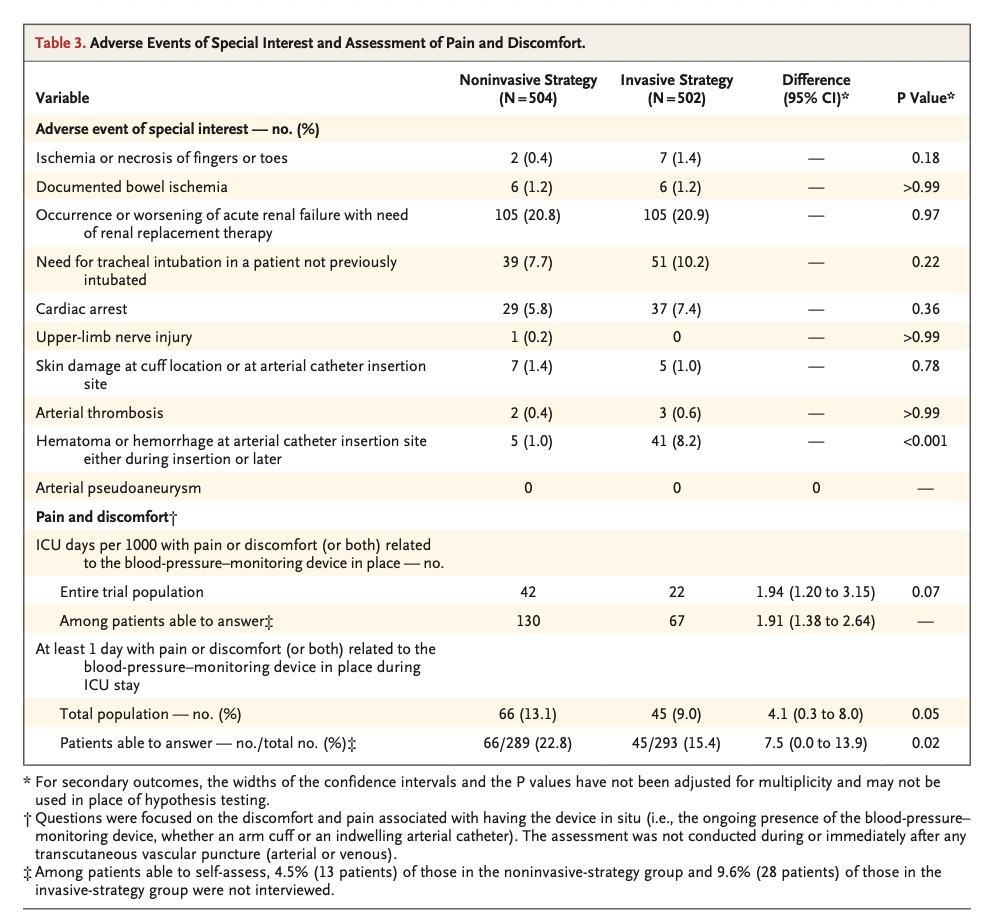
Results: A total of 1010 patients underwent randomization; 504 patients assigned to the noninvasive-strategy group and 502 assigned to the invasive-strategy group were included in the analyses. A total of 74 patients (14.7%) in the noninvasive-strategy group and 493 (98.2%) in the invasive-strategy group underwent insertion of an arterial catheter. Death within 28 days occurred in 173 patients (34.3%) in the noninvasive-strategy group and 185 (36.9%) in the invasive-strategy group (adjusted risk difference, -3.2 percentage points; 95% confidence interval, -8.9 to 2.5; P = 0.006 for noninferiority). Results of per-protocol analyses were similar in the two groups. A total of 66 patients (13.1%) in the noninvasive-strategy group and 45 (9.0%) in the invasive-strategy group had at least 1 day of pain or discomfort related to the ongoing presence of the blood-pressure-monitoring device. Hematoma or hemorrhage related to the arterial catheter occurred in 5 patients (1.0%) in the noninvasive-strategy group and 41 patients (8.2%) in the invasive-strategy group.共有1010名患者接受了随机分组;其中非侵入性策略组504名患者和侵入性策略组502名患者被纳入分析。非侵入性策略组中有74名患者(14.7%)、侵入性策略组中有493名患者(98.2%)最终接受了动脉导管置入。在第28天内,非侵入性策略组有173名患者(34.3%)死亡,侵入性策略组有185名患者(36.9%)死亡(调整后的风险差异为-3.2个百分点;95%置信区间为-8.9至2.5;非劣效性检验P=0.006)。符合方案分析的结果在两组间也相似。非侵入性策略组中有66名患者(13.1%)、侵入性策略组中有45名患者(9.0%)至少有一天因持续使用血压监测设备而感到疼痛或不适。非侵入性策略组中有5名患者(1.0%)、侵入性策略组中有41名患者(8.2%)出现了与动脉导管相关的血肿或出血。
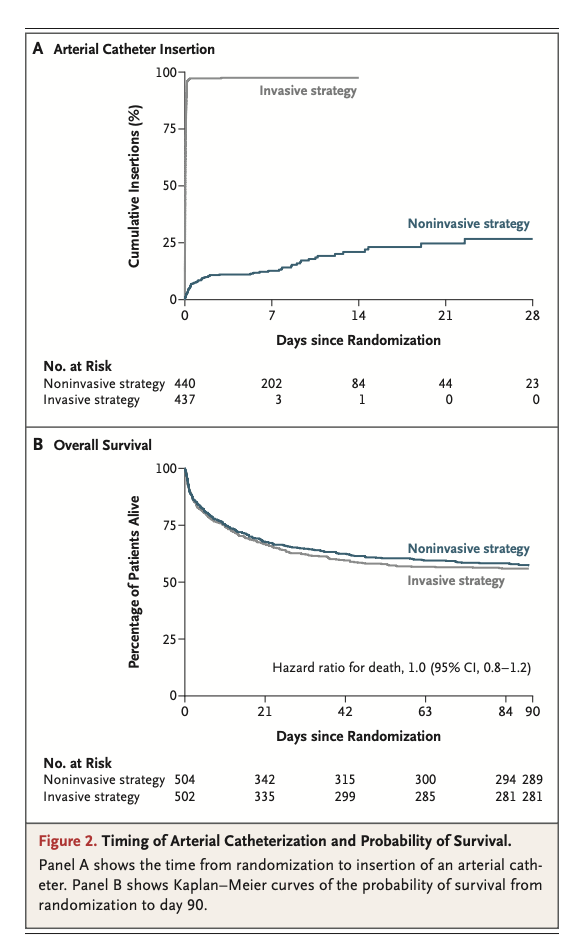
Conclusions: Among patients with shock, results for death from any cause at day 28 indicated that management without early arterial catheter insertion was noninferior to early catheter insertion. (Funded by the French Ministry of Health; ClinicalTrials.gov number, NCT03680963.). 在休克患者中,第28天全因死亡率结果表明,不进行早期动脉导管置入的管理策略不劣于早期置入动脉导管的策略。
相关评论的文章:https://mp.weixin.qq.com/s/C670Tw1KDl1OaXU2lI99Rw
EVERDAC试验的结果挑战了当前的临床实践指南。研究表明,对于多数休克患者,无创血压监测足以安全地指导治疗。
EVERDAC试验告诉我们,在休克患者的管理中,“少即是多” 的哲学再次得到验证—— 更保守的动脉导管使用策略不仅安全,而且可能对患者更有利。
这项研究鼓励临床医生重新思考常规做法,在保证医疗质量的同时,减少不必要的侵入性操作,让重症护理变得更加人性化。
对于ICU医生而言,现在是时候打破传统教条,基于证据而非习惯来选择监测策略了。对大多数休克患者,无创血压监测完全能够胜任,让患者少挨一针,却不影响救治效果
休克患者,你喜欢动脉不打吗??
原创文章(本站视频密码:66668888),作者:xujunzju,如若转载,请注明出处:https://zyicu.cn/?p=21023
 微信扫一扫
微信扫一扫  支付宝扫一扫