Abstract
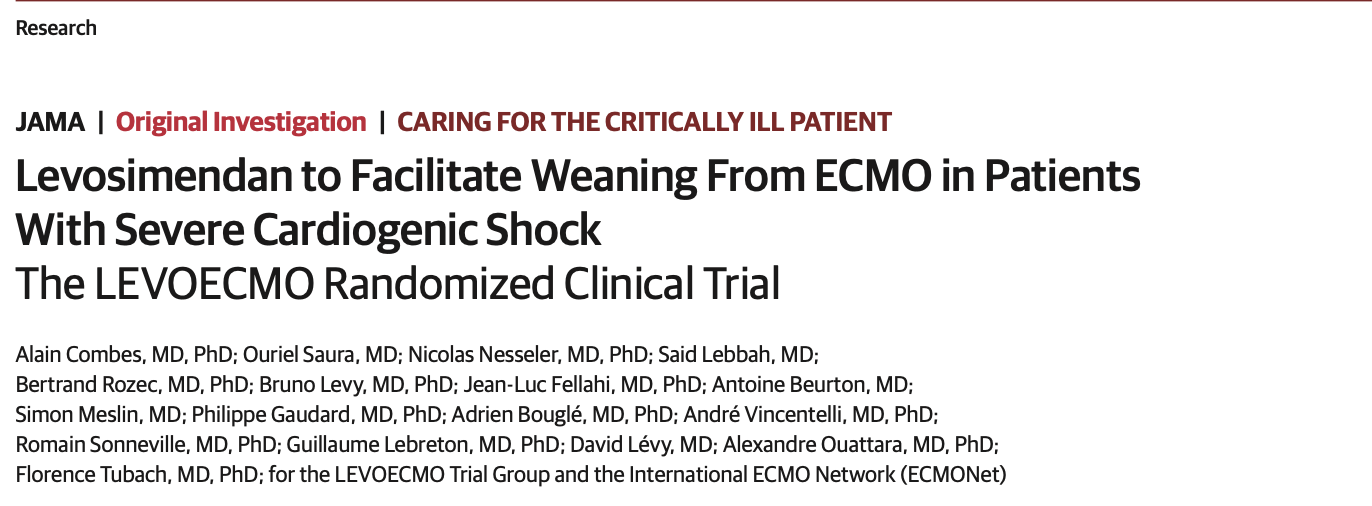
Importance: Levosimendan may facilitate weaning from venoarterial extracorporeal membrane oxygenation (VA-ECMO) and improve survival, but supporting evidence remains limited.
重要性:左西孟旦可能有助于从静脉-动脉体外膜肺氧合(VA-ECMO)脱机并改善生存率,但支持证据仍然有限。
Objective: To assess whether early administration of levosimendan reduces the time to successful VA-ECMO weaning in patients with severe but potentially reversible cardiogenic shock.
目的:评估早期给予左西孟旦是否能缩短严重但潜在可逆性心源性休克患者成功脱离VA-ECMO的时间。
Design, setting, and participants: Randomized, double-blind, placebo-controlled trial conducted across 11 intensive care units (ICUs) in France. Between August 27, 2021, and September 10, 2024, 205 adult patients with acute cardiogenic shock who had started VA-ECMO in the preceding 48 hours were enrolled. Final follow-up was completed on November 10, 2024.
设计、场所和参与者:在法国11个重症监护病房(ICU)进行的随机、双盲、安慰剂对照试验。2021年8月27日至2024年9月10日期间,共纳入205名在入组前48小时内开始使用VA-ECMO的急性心源性休克成年患者。最终随访于2024年11月10日完成。
Interventions: Patients were randomized in a 1:1 ratio to receive levosimendan, 0.15 μg/kg per minute, to be increased to 0.20 μg/kg per minute after 2 hours (n = 101), or placebo (n = 104).
干预措施:患者按1:1比例随机分配接受左西孟旦(初始剂量0.15 μg/kg/分钟,2小时后增至0.20 μg/kg/分钟,n=101)或安慰剂(n=104)。
Main outcomes and measures: The primary outcome was time to successful ECMO weaning within 30 days following randomization. Secondary outcomes included ECMO-, mechanical ventilation-, and organ failure-free days, ICU and hospital lengths of stay, serious adverse events, and all-cause 30- and 60-day mortality.
主要结局和测量指标:主要结局为随机分组后30天内成功脱离ECMO的时间。次要结局包括无ECMO天数、无机械通气天数、无器官衰竭天数、ICU及住院时长、严重不良事件以及30天和60天全因死亡率。
Results: Among the 205 randomized patients (median age, 58 [IQR, 50-67] years; 149 [72.7%] male), main cardiogenic shock etiologies were postcardiotomy (79 [38.5%]), acute myocardial infarction (56 [27.3%]), and myocarditis (28 [13.7%]). Treatment dose was increased to 0.20 ± 0.01 μg/kg per minute in 93% of patients receiving levosimendan and in 96% of those receiving placebo. Within 30 days, 69 of 101 patients (68.3%) had a successful ECMO weaning in the levosimendan group compared with 71 of 104 (68.3%) in the placebo group (risk difference, 0.0% [95% CI, -12.8% to 12.7%]; subdistribution hazard ratio, 1.02 [95% CI, 0.74-1.39]; P = .92). In the levosimendan and placebo groups, respectively, median ECMO duration (5 [IQR, 4-7] days vs 6 [IQR, 4-11] days; P = .53), mean ICU length of stay (18 [SD, 15] days vs 19 [SD, 15] days; P = .42), and 60-day mortality (27.7% vs 25.0%; risk difference, 2.7% [95% CI, -9.0% to 15.3%]; P = .78) did not differ significantly. Ventricular arrhythmias occurred more frequently with levosimendan (18 [17.8%] vs 9 [8.7%]; absolute risk difference, 9.2% [95% CI, 0.4%-18.1%]).
结果:在205名随机患者中(中位年龄58岁[IQR, 50-67];男性149人[72.7%]),心源性休克的主要病因为心脏术后(79例[38.5%])、急性心肌梗死(56例[27.3%])和心肌炎(28例[13.7%])。接受左西孟旦的患者中有93%将剂量增加至0.20±0.01 μg/kg/分钟,安慰剂组为96%。30天内,左西孟旦组101例患者中有69例(68.3%)成功脱离ECMO,安慰剂组104例中也有71例(68.3%)成功脱机(风险差异0.0%[95%CI, -12.8%至12.7%];亚分布风险比1.02[95%CI, 0.74-1.39];P=0.92)。左西孟旦组与安慰剂组的中位ECMO持续时间(5天[IQR, 4-7] vs 6天[IQR, 4-11];P=0.53)、平均ICU住院时间(18天[SD, 15] vs 19天[SD, 15];P=0.42)及60天死亡率(27.7% vs 25.0%;风险差异2.7%[95%CI, -9.0%至15.3%];P=0.78)均无显著差异。左西孟旦组室性心律失常发生率更高(18例[17.8%] vs 9例[8.7%];绝对风险差异9.2%[95%CI, 0.4%-18.1%])。
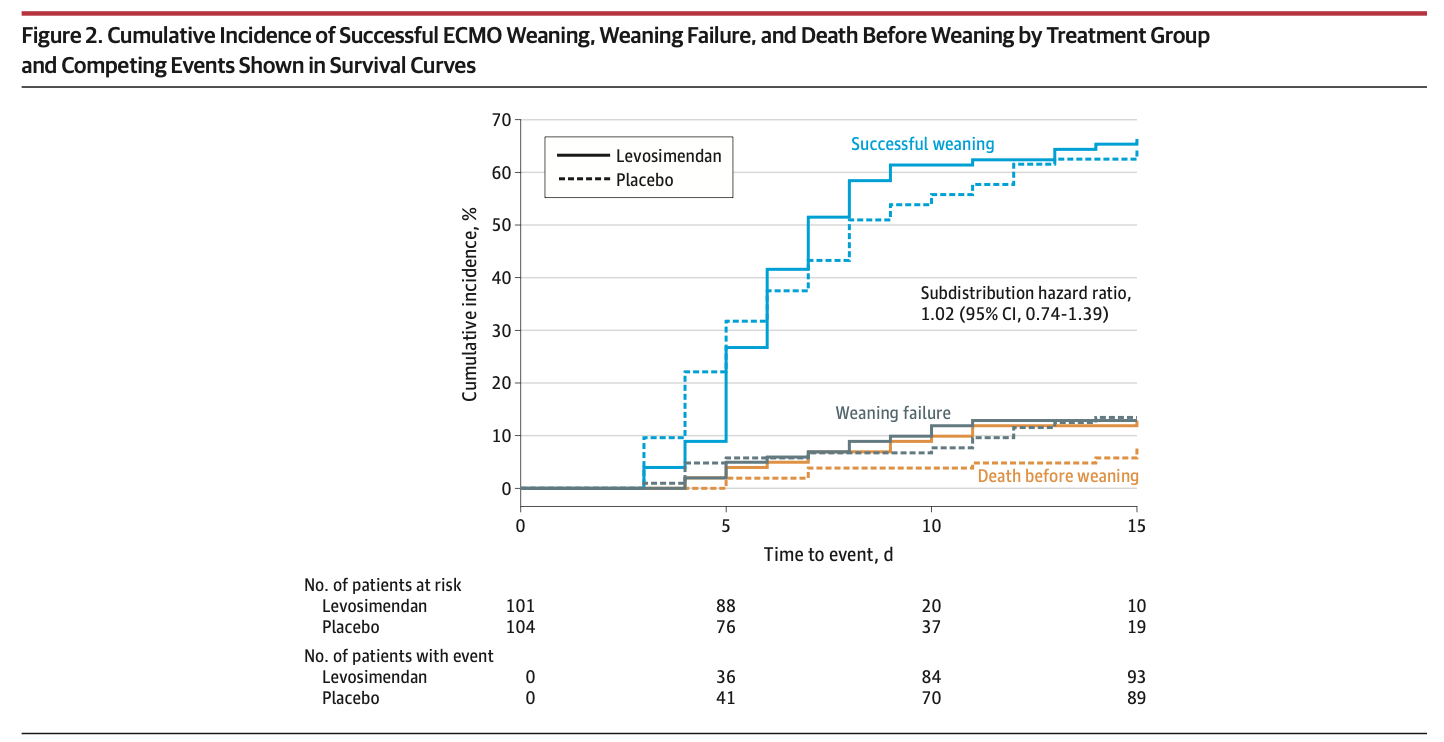
Conclusions and relevance: Among patients with severe but potentially reversible cardiogenic shock supported by VA-ECMO, early levosimendan administration did not significantly reduce the time to successful weaning of ECMO compared with placebo.
结论和相关性:在接受VA-ECMO支持的严重但潜在可逆性心源性休克患者中,与安慰剂相比,早期给予左西孟旦并未显著缩短成功脱离ECMO的时间。
原创文章(本站视频密码:66668888),作者:xujunzju,如若转载,请注明出处:https://zyicu.cn/?p=21465
 微信扫一扫
微信扫一扫  支付宝扫一扫